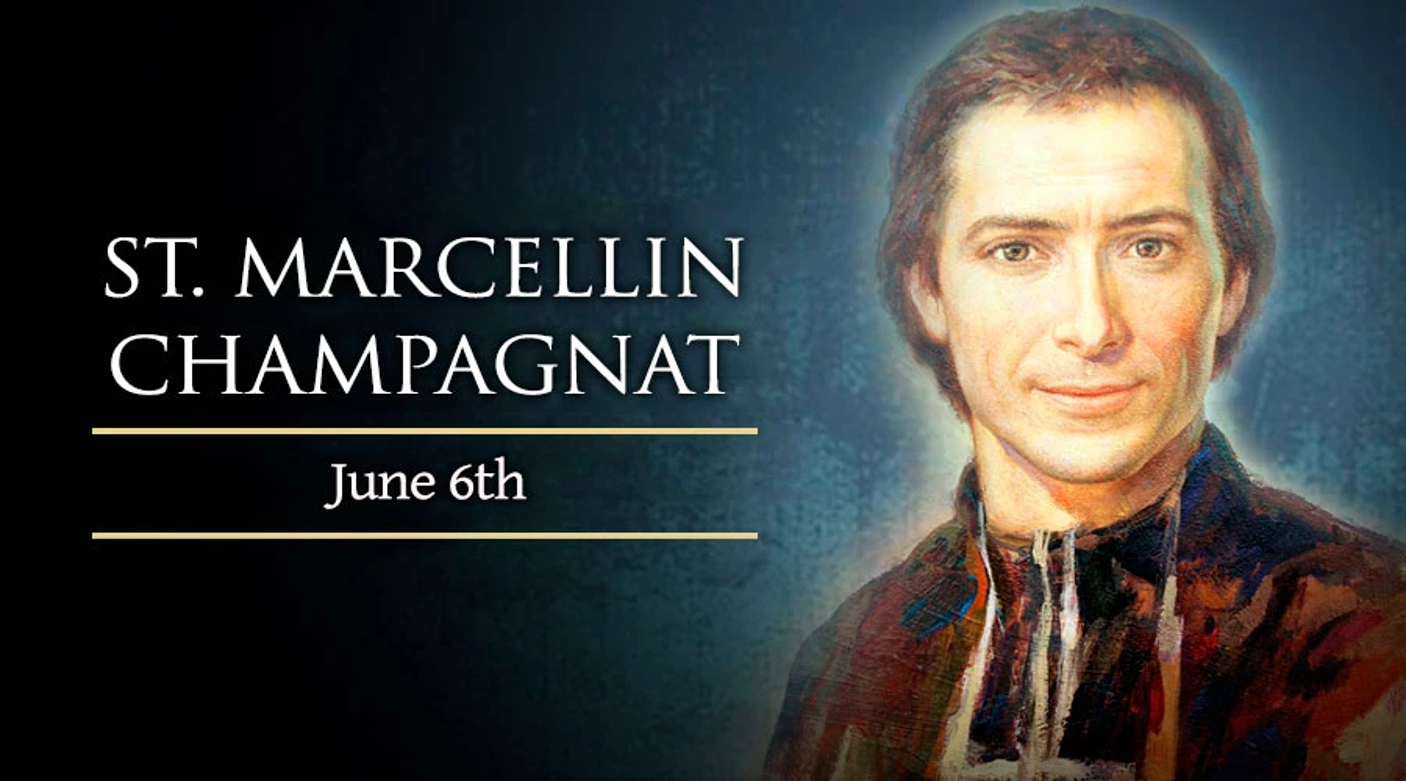
“All to Jesus through Mary, and all to Mary for Jesus.” – St. Marcellin Champagnat
Marcellin Champagnat was born on May 20, 1789, the year of the French Revolution, and died on June 6, 1840. He was a priest of the Society of Mary and the founder of the Little Brothers of Mary, a congregation devoted to the education of the young.
He was the ninth child of a very pious Catholic family and developed a deep devotion to Mary as a young boy, which he learned from an aunt who was a religious sister. He also inherited a strong capacity for work from his father.
Champagnat left school at the age of seven. At 14, through the guidance of a priest, he discovered his vocation to the priesthood and had to begin studying again almost from scratch.
Aware of his limitations, and against the advice of those around him, he entered the minor seminary and struggled to learn the fundamentals of schooling. Never losing sight of God’s will, he persevered through these difficult years with his eyes fixed on the horizon of God’s call.
In the major seminary, he became friends with Jean‑Marie Vianney, the future Curé of Ars. He was ordained with his companions on July 22, 1816, the feast of St. Mary Magdalene.
One of his desires was to found a congregation devoted to Mary in order to re‑evangelize French society in the wake of the Revolution. He saw his main task as the Christian education of the young, a mission confirmed when he encountered a dying boy who had little knowledge of the faith.
On January 2, 1817, he founded the Little Brothers of Mary when two young men joined him in his mission. Alongside his parish ministry, he dedicated himself to educating uncultured boys and forming them into ardent apostles of Christ, living in poverty and trusting completely in God’s will and the protection of the Virgin Mary.
Marcellin Champagnat died at the age of 51, his health worn out by immense work and illness.
At his canonization in 1999, Pope John Paul II said:
“St. Marcellin proclaimed the Gospel with a burning heart. He was sensitive to the spiritual and educational needs of his time, especially to religious ignorance and the situations of neglect experienced in a particular way by the young.”